Neglected or Misunderstood: Introducing Theodor Adorno by Stuart Walton
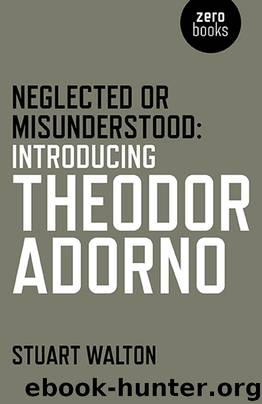
Author:Stuart Walton [Walton, Stuart]
Language: eng
Format: epub
ISBN: 978-1-78535-383-3
Publisher: John Hunt (NBN)
Published: 2017-08-12T04:00:00+00:00
The cause of dialectics was not helped in the twentieth century by its petrifaction into an approved methodology in the Soviet system. To Adorno, this was consummate absurdity, because the function of dialectics is to illuminate the wrong state of things. If society were to be truly pacified, freed from the dominative structures of present oppression, it would have no need of dialectical thinking, and in any case, dialectics, as Engels himself defined it, is an account of the total dynamics of a system, its ebbs and flows, its risings and fallings away, the permanent state of becoming in which it existed. It isn’t simply a language to be learned, or a rhetorical mode to be adopted and applied to any phenomenon that falls within its ambit.
In a reflection on dialectics towards the end of Minima Moralia, Adorno already anticipated the arguments he would put in greater depth and intricacy in the Negative Dialectics twenty years later. He begins by tracing a lightning history of its development. In the Sophist tradition of ancient Greece, it represented a means by which an apparently ingrained position could be overturned by argument, so that what started out as the weaker position became the stronger. In the Platonic dialogues, it has become a perennially applied procedure, the principle by which the normativity of received opinion can be tripped up. It is already, Adorno notes, an instrument of domination, if all it does is prove one of two thinkers right. Whether it contains anything of truth, therefore, derives not from the method itself, but from the motivation with which it is put to use at different historical junctures. He states that its bifurcation into left and right schools after Hegel’s death reflected not only the prevailing political contest in Germany in the period leading up to the liberal revolutions of 1848, but also the fact that it was in itself profoundly ambiguous in nature. If it had high-minded historical purpose in the Marxist version, in which the proletariat would transform itself from the object into the subject of history by overturning bourgeois society, thereby abolishing itself as a class into the bargain, it also had a ludic, satirical side. He references a cartoon by the French illustrator Gustave Doré, in which a surviving representative of the old order pompously remarks that, really, Louis XVI is to be credited with the Declaration of the Rights of Man, because without him, there would have been no revolution. This is not just an ironic squib, but also an impeccable piece of dialectical thinking, perhaps recalling Brecht’s observation that nobody who lacked a sense of humour would understand dialectics. That much ought to be straightforward enough. From this point on, however, Adorno subjects the operation of the dialectic itself to a dialectical analysis.
Dialectics, it will be recalled, is predicated on the notion of sublation, the simultaneous overcoming and retention of the contending terms in an opposing pair. Not only the old form of an argument is liquidated, but so is the means by which it is liquidated.
Download
This site does not store any files on its server. We only index and link to content provided by other sites. Please contact the content providers to delete copyright contents if any and email us, we'll remove relevant links or contents immediately.
| Anthropology | Archaeology |
| Philosophy | Politics & Government |
| Social Sciences | Sociology |
| Women's Studies |
The remains of the day by Kazuo Ishiguro(9002)
Tools of Titans by Timothy Ferriss(8402)
Giovanni's Room by James Baldwin(7351)
The Black Swan by Nassim Nicholas Taleb(7136)
Inner Engineering: A Yogi's Guide to Joy by Sadhguru(6798)
The Way of Zen by Alan W. Watts(6619)
The Power of Now: A Guide to Spiritual Enlightenment by Eckhart Tolle(5788)
Asking the Right Questions: A Guide to Critical Thinking by M. Neil Browne & Stuart M. Keeley(5778)
The Six Wives Of Henry VIII (WOMEN IN HISTORY) by Fraser Antonia(5518)
Astrophysics for People in a Hurry by Neil DeGrasse Tyson(5194)
Housekeeping by Marilynne Robinson(4453)
12 Rules for Life by Jordan B. Peterson(4308)
Ikigai by Héctor García & Francesc Miralles(4277)
Double Down (Diary of a Wimpy Kid Book 11) by Jeff Kinney(4276)
The Ethical Slut by Janet W. Hardy(4261)
Skin in the Game by Nassim Nicholas Taleb(4255)
The Art of Happiness by The Dalai Lama(4132)
Skin in the Game: Hidden Asymmetries in Daily Life by Nassim Nicholas Taleb(4010)
Walking by Henry David Thoreau(3966)
